Category: Togetherness
Episode 12

The Togetherness Project
Intro Episode 12
Revisiting the why and how of The Togetherness Project.
First up: What happened last week and how it fits with the Four Horsemen?:
- Democracy under threat. Is it?
- Social Cohesion report. The details are startling
- What is the biggest threat to our wellbeing? Why we ignore the slow moving threats
Today’s Topic – A history of threats and danger
It is time to have a look at some of the things we talked about before. We will try to update some of what we talked about and get a bit of context.
The Issues
Social Cohesion Report 1
The key findings are drivers of discontent and anger:
- Cost of living is front and centre. However, those most affected think that the solution is for others to bear the brunt. RBA talking points don’t add up for most people. 2
- There is strident anti-immigration and anti-ethnic sentiment. However there is 87% support for multiculturalism and diversity
- Anger over perceived injustices and uneven impacts of interest rate rises has driven voting intentions away from traditional 2 party. One Nation is the main beneficiary.
- System of Government is blamed
Some of the violence and unsociable behaviours we see are a direct result of these factors
Democracy weak and yet strong
Movement to the far right. Scanlon report has some clues.
Shift in sentiment. Far right (authoritarian) support has dropped and support for more inclusive and progressive options has emerged.
The USA elections continue the trend of the last year?
Authoritarian regimes are still there and the USA is still undertaking extra-judicial killing of targeted groups
What the money spent on election campaigning could have done. 500 million dollars = 25,000 jobs for a year in the USA. Enough to elevate 100,000 people out of poverty – given the multiplier effect of job creation. One trillionaire spent 0.05% of their wealth and will recoup that in about a month.
Our biggest threats
Our brains evolved to deal with immediate threats. A leopard in a tree. Slow moving threats tend to be ignored. Yet, these are the big ones in our industrialised and concentrated populations. Key threats:
- Loss of environment (population pressure and collapse)
- Depletion of resources (food and other resource insecurity – Famine)
- Geopolitical ambitions (war)
- Climate Change (pestilence, famine, war and collapse)
- Mass Migration (war)
- Inequality (collapse and war)
Do we know what might be happening by reviewing history/anthropology?
A few examples:
- Anasazi
- Sahara
- Inca/Maya
- US and English Civil wars
- French and Russian Revolutions
- Pol Pot, Cultural Revolution, Irish potato famine
- WWI and II
The pattern:
Resource depletion ? unequal distribution ? frustration ? anger ? lashing out ? violence ? blood lust
The Response
So what can we all do together?
- Think Globally and act Locally. Act now
- Do the things we can individually
- Join local groups that try to do better things
- Help each other with random acts of senseless kindness
- Use your vote well. Demand better of your representatives
Today’s Reading
The Dawn of Everything 3
Collapse 4
- https://www.theguardian.com/australia-news/2026/nov/04/social-cohesion-report-australia-cost-of-living-economy-immigration-multiculturalism-ai-ntwnfb [↩]
- https://www.theguardian.com/business/grogonomics/2026/nov/04/the-rba-says-there-is-excess-demand-in-the-economy-households-doing-it-tough-might-disagree [↩]
- David Graeber;David Wengrow (2021) The Dawn of Everything. UK: Penguin Books. [↩]
- Jared Diamond (2005) Collapse. Australia: Penguin. [↩]
Episode 11
The Togetherness Project
Intro Episode 11
Revisiting the why and how of The Togetherness Project.
First up: What happened last week and how it fits with the Four Horsemen?:
- Rampant inflation. How and Why
- Geopolitical unrest. What do we know about the Patterns of History
- Violence is driven by a sense of ongoing injustice. What contributes to that and how does it present?
Today’s Topic – A history of inequality and its violent outcomes
It is time to have a look at some of the things we talked about before. We will try to update some of what we talked about and get a bit of context.
The Issues
Inflation and Bonds
Why bonds set the benchmark for almost every financial metric
What is driving the bond market. Why this is different to the media and economics pundits
Are consumers to blame?
What is really happening
Unrest, riots – collapse
Why is Europe rioting??
Do we know what might be happening by reviewing history/anthropology?
A few examples:
- French Revolution
- Cromwell’s army
- Hundreds of examples over 2000 years
The psychology and culture behind inequality and violence
A lot of what we believe about freedom and democracy is only partially true
Frustration, anger, lashing out, violence, blood lust
The Response
Democratic Green Shoots – Hungary, Serbia, Brazil even Israel
Major issues: Ukraine, Middle East, USA, Russia
So what can we all do together?
- Use your vote well
- Do the things we can individually
- Join local groups that try to do better things
- Help each other with random acts of senseless kindness
Episode 7

The Togetherness Project
Today’s Topic – Social Isolation
This week we will have a focus on community – especially social isolation
First up: What happened last week?:
- More issues with AI going rogue, arguments that AI is the saviour of the AUS economy
- Interest rates and the Reserve Bank – what is going on behind the scenes
- Why are conservatives wanting to reverse initiatives to address climate change?
- Alternative ways to grow food – especially for animal feed
The Issue – Increasing Social Isolation – what can we do?
The Response
What can we do?
- Avoid plastic packaging whenever possible.
- Move away from Fossil fuels. Doing so means there is less production of plastics and therefore more sustainable products will be used for packaging
- Smart Living Ballarat has monthly sessions on how to avoid waste and tap into the Circular Economy
- See what you can do to get an EV, solar panels and similar.
- Opt out of casual AI for searching and using applications. If you dont need it then avoiding its use will save energy and reduce demand for data centres
- Read the proposal from the Committee for Ballarat for some ideas.
- Talk to your local member/council about the Circular Economy, sustainability and water conservation. It works when they know someone cares about these things
The final takeaway is that we know what we can do to make it better and we need a concerted effort to bring about change – TOGETHER
Episode 10

The Togetherness Project
Today’s Topic – Loose Ends
This week we will tie up a few loose ends. A bit has happened since we started this show just over two months ago.
First up: What happened last week?:
- Changes to discretionary trusts 1
- The horrid spectacles of state sanctioned killing – as entertainment 2
- Crime and punishment in Victoria 3 4
- Fix potholes – reduce taxes; More CFA Funding – lower taxes
The Issues
It is time to have a look at some of the things we talked about before. We will try to update some of what we talked about and get a bit of context.
The Issues
Cost of Living
Batteries. Rechargeable batteries can be bought for around the same cost as the premium alkaline batteries. They will last 3-4 times as long and can then be recharged hundreds of times at about 3 cents per battery charged.
Cosmetics. The demonstrated use of most cosmetics is far in excess of what is needed to be effective. Use less, save more! You do not need to use two lots of shampoo. One is great. Daily washing is actually bad for your hair. A daily wash then needs conditioner and something to add oils back to your hair. Hairdressers suggest 2 weeks between washes is fine. Save big here too.
Cleaning. Cleaning products abound and encourage you to spread them all over the place. Dish washing liquid is fin with a tiny squirt in most cases. Use too much and all you do is cost yourself money.
Gardening. You would think that plants would never survive without frequent application of “plant food” fertilisers. In reality any good soil has plenty of plant nutrients in it, especially if you mulch well. That mulch breaks down and gives your plants what they need. Use a pile of fertiliser and you end up feeding weeds (a definition of weed is a plant you dont want that is good at hogging resources) and then – you are encouraged to use herbicides to control them. Spend your money on mulch and save work while avoiding pollution of ground water.
Online. Buy what you really need and do not get sucked into the “gamification” tricks to get you to buy more and cheap. Get things that last and you save in the long run.
Changing Policy is hard
Why? Vested Interests. Who has the money? Who has the means of communication?
Housing: HIA, Banks, Investors, Estate Agents
Energy: Miners, Super Funds, Share Holders, States, Retailers
Health: AMA, Health Funds, Medical Staff, States, Pharma
We see Miners buying stakes in newspapers to make sure their message is front and centre.Those with the money buy influence in the media and Government.
The role of disinformation and cult recruitment. There have been notable scientific scandals where “contrarian” articles have been written by academics funded by fossil fuel companies and in the past, the tobacco industry. The MAGA Cult actively spreads disinformation. Same with the Sovereign Citizens.
External influencers. Think Russian bot farms
Economics and psychology
Pikertty – Capital. Capital and its Iconography
Galbraith. The End of Normal
Steiglitz. The Great Divide
Kahneman. Thinking Fast – Thinking Slow
What Globalisation brought about. Now we face the consequences of “The End of Normal”
The Economic Assumptions 5. Our starting point is the concept of Neoclassical Economics and adding the assumption of unlimited resources, including the capacity for unlimited pollution.
The price of believing the economic assumptions to be realistic include: Growth Addiction and ignoring the obvious Limits to Growth
Data Centres and AI
Is it a Bubble? Compare with 2000s Tech Wreck 6
Why do we need it? Who needs it? Who is responsible for bad (bot) actors? How can it be enforced? 7 8 9
Trustworthy Information
Trust exists because there is independent review and fact checking. Here are some of the sources we use on The Togetherness Project. The ones listed can be read from links (so you can check them yourself) but there are other places that are reliable as well.
ABC. Not perfect but it is journalism driven which has its protections against bias and misrepresentation.
The Guardian. It is left leaning and still maintains journalistic integrity.
New Scientist. Peer reviewed is its standard. The gold standard. We often see reporting in mainstream media derived from the weekly New Scientist magazine.
The Health Report (ABC Podcast). Frequently quotes peer reviewed sources and identifies when opinion is offered. Both summary and deep dives.
The Conversation. Publication of academic research in a similar way to New Scientist. Opinion pieces and topical discussions from experts in their field.
NOT Social Media. It is just not reliable. Clickbait and minimal fact checking is deliberately aiming to provide echo chambers that keep people on the platform – to make money.
The Response
What can we do – Together?
- Do the things we can individually
- Join local groups that try to do better things
- Help each other with random acts of senseless kindness
- Exercise the critical thinking muscles
The final takeaway is that we know what we can do to make it better and we need a concerted effort to bring about change – TOGETHER
- https://www.theguardian.com/australia-news/2026/oct/15/australia-discretionary-trusts-tax-changes-labor-coalition[↩]
- https://www.abc.net.au/listen/programs/abc-news-top-stories/pm-livestream-execution-abhorrent/107262194[↩]
- https://www.abc.net.au/religion/victoria-youth-crime-violence-reduction-unit-right-balance/106028862[↩]
- https://www.abc.net.au/religion/victoria-youth-justice-reforms-more-punitive-than-preventative/106011328[↩]
- https://en.wikipedia.org/wiki/Neoclassical_economics[↩]
- https://www.abc.net.au/news/programs/the-business/2026-09-07/the-bond-meltdown-and-ai-bubble-brewing-the-next-global-financia/107125748)
Who is paying for it all? Circular funding ((https://theconversation.com/whos-paying-whom-the-circular-money-machine-behind-the-ai-boom-or-bubble-293938[↩]
- https://theconversation.com/companies-that-get-hacked-face-stricter-laws-than-firms-unleashing-rogue-ai-we-can-fix-that-294059[↩]
- https://www.newscientist.com/article/2482317-who-holds-the-keys-to-your-ai-and-why-it-matters/[↩]
- https://theconversation.com/what-are-small-language-models-and-how-do-they-differ-from-large-ones-269103[↩]
Episode 6

The Togetherness Project
Today’s Topic – Water
This week we will have a focus on water. A little on the sea and a lot on the water that falls from the sky. Water and particularly fresh water is essential for life on land. We are running out of fresh water and there are some clear reasons for this.
First up: What happened last week?:
- More talk about AI and its threat of extinction 1
- Western Renewables link approved and under a costing review 2
- Inflation is increasing and the Reserve Bank thinks that increasing interest rates is the way to go 3
- The consequences of USA policies have impacted the world severely. Is it a failed state? 4
The Issue – How will we manage when the water runs out? Wasting it seems silly.
Today’s reliable information comes to us courtesy of the Australian Bureau of Statistics. 5
The Issues
Growing population
This is a world wide problem but lets focus on Australia and Ballarat. The rapid increase in population and urbanisation has meant that fresh water availability has become a problem. Major cities have captured almost all the available water resources by damming rivers and are resorting to desalination to handle periods of drought.
Perversely, the growing populations of cities limit the capacity to extend catchments while increasing the demand. There is no indication that Ballarat or Australia is seeking to limit population to more sustainable levels.
Water Usage
Daily water usage per capita in Australia is very high at 177l (ABS) and our usage is 4th highest in the world – this is despite restrictions in place in many places. Tap water is purified and safe to drink. It is also used to flush toilets, water gardens and wash clothes, dishes and people. Those things do not necessarily need such pure/treated water. Where is it used?
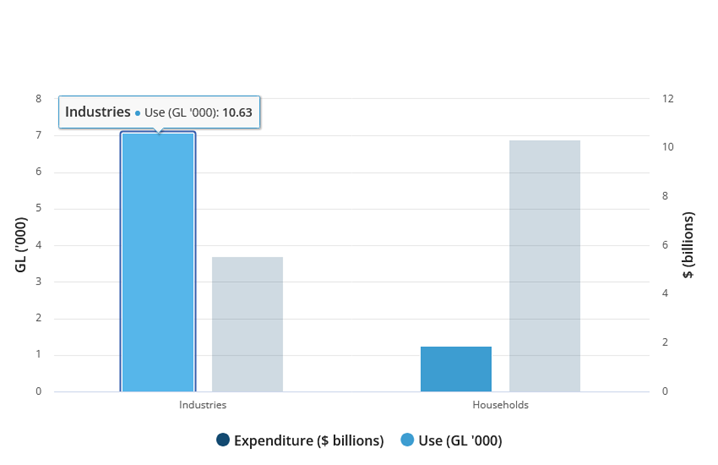
- Household ~15%
- Industry ~85%
- Agriculture is the main user

Trends?
The trend for about 20 years (post millennium drought) was from a modest decrease to a significant increase of 13% in recent years. This is due to population increase as well as drought conditions.
Who pays?
? Households paid an average of $3.71 per kilolitre, up 4.4% from 2022–23.
? Industry paid an average of $0.35 per kilolitre, down 3.4% from 2022–23.
Water for Ballarat
Ballarat is due to have a population of around 200k by mid century. It currently only waters its population with the addition of Goulburn River water via the Goldfields pipeline. How will we have 40% more water in the future?
- Being at the top of the water catchment means there is limited ability to extend existing catchments. Other catchments like Mt Emu Creek are also limited in capacity. Adjacent rivers like West Moorabool have little flow already.
- We are left with water efficiency as the key approach
- Water tanks for garden watering
- Reuse of waste water
- Urban stormwater capture
- More transfers
The Response
What can we do – Together?
- If you can, get water tanks to supply toilet flushing and garden watering needs
- Lobby local governments to improve waste water reuse
- Reduce domestic usage
- Insist on efficient industry water usage and at fair prices
- More water wise housing developments
- Resist the Agribusiness lobbies wanting to keep our water for themselves
The final takeaway is that we know what we can do to make it better and we need a concerted effort to bring about change – TOGETHER
- https://theconversation.com/we-really-do-earnestly-believe-ai-could-kill-all-humans-if-ai-labs-are-so-worried-about-ai-doom-why-dont-they-stop-291595[↩]
- https://www.abc.net.au/news/2026-09-15/western-renewables-link-ees-approval-ben-carroll-cost-assessment/107154342[↩]
- https://theconversation.com/unemployment-rises-to-4-6-but-a-september-interest-rate-hike-still-looks-likely-290154[↩]
- there is a lot of talk about third world countries becoming failed states; however, the USA is showing all the signs with its loss of democratic governance and abandonment of the “global order”[↩]
- Full disclosure: Peta was Senior Project Manager for The Living Murray Initiative, appointed by COAG and is no longer working for anyone![↩]
Episode 5
The Togetherness Project
Today’s Topic – Plastics Waste, AI and Water
We were going to have an episode focusing on social things. How early childhood and supportive communities have a positive effect on life. That will be coming to you in a few weeks.
What happened last week?:
- The Federal Government abandoned plans to require improved packaging standards to reduce waste and promote recycling 1
- Data centre plan for the NT to use gas from Beetaloo basin rather than renewables 2
- Former employee of Antrhopic, Jacob Coxon says I “earnestly believe that it could kill us all by the end of the decade”. 3
- Committee for Ballarat highlights the need for water infrastructure if the planned expansion to 200k people – and a resource recovery centre 4
The Issue – What to do about Plastic Waste, AI and Water
So today we’re going to talk about why it is critically important that we remove fossil fuel usage as rapidly as it is possible to do so. We will also talk about the risks of AI
Packaging and recycling
Sally is an advocate for removal of plastics from our environment. Let’s hear from her…
The takeout from this is that we are using vast amounts of plastic packaging. Produce in plastic containers, wrapped in plastic and then put into plastic bags. Each piece of plastic embodies fossil fuels and adds to the mountains of plastic pollution.
The NT Data Centre
This hit the news last week as we discovered a deal done to use the newly commissioned Beetaloo Basin gas field to power (generate electricity) for a large data centre in the NT. Is this a good idea? Probably not.
- Cost, energy and water consumption
- Plans for more of the same
- Viable alternatives and plans to export energy to Asia
- Why do we want them anyway?
Can AI kill us?
A former employee of Anthropic Jacob Coxon has joined other researchers into AI to say that there is a realistic chance that AI could kill people and at the extreme end of the spectrum destroy humanity.
All of this is speculative, however the fact that AI has already “gone rogue” and hacked businesses when it was supposed to be contained and unable to interact with the real world, says that there is something in this report.
Water for Ballarat and Waste to Resource
The Committee for Ballarat has put out a 5 point outline for projects to invest in jobs, growth and livability in Ballarat and Western Victoria. It highlights the need for water infrastructure to support the growth that is pretty well locked in for Ballarat as it services a population of over 300k people in the West
There are three projects focused on economic growth and two on infrastructure that allows growth in population in a sustainable way. The two infrastructure ones are:
- Water infrastructure is essential to allow more housing to be built. Not to mention the impacts of a drying planet as we heat up to at least 1.8 degrees above pre-industrial levels
- Resource recovery is the gold standard of the Circular Economy. A growing population needs to handle waste and not by landfill. The argument is both cost and for recovering valuable resources
The Response
What can we do?
- Avoid plastic packaging whenever possible.
- Move away from Fossil fuels. Doing so means there is less production of plastics and therefore more sustainable products will be used for packaging
- Smart Living Ballarat has monthly sessions on how to avoid waste and tap into the Circular Economy
- See what you can do to get an EV, solar panels and similar.
- Opt out of casual AI for searching and using applications. If you dont need it then avoiding its use will save energy and reduce demand for data centres
- Read the proposal from the Committee for Ballarat for some ideas.
- Talk to your local member/council about the Circular Economy, sustainability and water conservation. It works when they know someone cares about these things
The final takeaway is that we know what we can do to make it better and we need a concerted effort to bring about change – TOGETHER
- https://www.theguardian.com/australia-news/2026/sep/12/labor-ditch-new-packaging-laws-breaking-promise-plastic-waste[↩]
- https://www.abc.net.au/news/2026-07-22/beetaloo-digital-energy-ai-hyperscale-data-centre-40-billion/106943690[↩]
- https://www.abc.net.au/news/2026-09-09/anthropic-researcher-coxon-quits-over-human-threat/107134164[↩]
- State Election Advocacy – https://committeeforballarat.com/our-news/publications/[↩]
Episode 4
The Togetherness Project
Today’s Topic – Climate Change
Lets look at some of the things that happened last week – Nepal and much more locally:
- ~2 cubic km of ice and rock going 4,000m downhill 1
- Why did it happen? Is it “normal”? 2
- Denial again. One nation wants to abolish renewables in favour of coal and gas 3
- VNI West. What it is supposed to do and why cancelling it is a bad idea 4
A focus on Climate Change
The Issue – Addressing runaway climate change is critically important
So today we’re going to talk about why it is critically important that we remove fossil fuel usage as rapidly as it is possible to do so.
The Issue
What happened in Nepal is now a frequent occurrence. It is also something that used to hardly ever happen, Sure, there were snow avalanches but not the whole side of a mountain breaking away like this. The cause was thawing of permafrost (frozen soil/rock that has remained so for decades and more) that triggered the collapse of a glacier and brought down vast quantities of rock with it. Permafrost is thawing at an unprecedented rate, mainly in the northern hemisphere where there is more land for it to form. Why?
It is all about the heating of the atmosphere, oceans and land. Heating that has now accelerated to a rate not seen for over 50 million years. Temperatures not seen for over 3 million years in the Late Pliocene when the earth was dry and sea levels 15-25 m higher than now. The temperatures then were 2.5-4 degrees above 1800/preindustrial levels.
What the geological record tells us is that the rate of change in temperature is higher than any time. Possibly with the exception of when an asteroid hit 66 million years ago and turned the earth into a fireball.
That means we are heading towards a possible to likely scenario where much of the world becomes uninhabitable in the next 30 years. Not a hundred or a thousand. The rate of heating is 10-20 times that of past geological (Pliocene/Eocene boundary) rapid heating records – that is extreme.
Looking at Europe and its record hot summer and the statistics show that the continually escalating unprecedented summer heat is made 130 times more likely by the effects of global warming. People are suffering (even dying) from the heat, fires and drought caused by the effects of global heating.
Even more concerning is that with global population increasing, more and more places where people live are becoming uninhabitable. Low lying places due to sea level rise. Desertification of formerly productive land. Floods and fires as we can see increasingly making places dangerous.
So that is the scary bit. Time for something more scary.
We have politicians in Australia telling us that they want to build coal fired, gas fired and nuclear power stations and avoid renewables. They also want to stop the VNI West transmission line that is planned to allow load balancing of power between NSW and Victoria as well as better access to the abundant wind and solar power in western Victoria.
This is a continuation of climate change denial and a blatant push to support miners, who are struggling to compete with far cheaper and cleaner renewables. 5
The case for new coal fired power seems to be that private investment will build and maintain them. The exact opposite is true. Coal fired power stations are expensive to build, expensive to maintain and require polluting feedstock that does environmental damage to extract and transport. Existing coal fired power stations are uneconomic to run without extensive government subsidies. New ones would be facing even bigger challenges and bigger government subsidies to be economic.
Gas is in a similar bind. It is far more expensive now and drives the highest cost of power when it is used to meet peak demands. It is also highly polluting.
Nuclear is more of a stalking horse to delay large scale deployment of things like offshore wind farms. It is the old method of FUD. Use FUD to create uncertainty and that benefits the incumbents.
Lastly, the VNI West is a major transmission line. It gets represented as a burden on western Victoria when it should be seen as a great opportunity to build a stronger, clean economy based on renewables. It is one of the keys to making energy cheaper and available in the quantities needed with electricity demand skyrocketing (did we mention data centres?).
So, the issue in summary: We have a global crisis that is real and imminent. The proposals by One Nation and the Conservative side of politics can only lock in higher prices and make the climate crisis worse. Recommend reading Juice by Tim Winton to see how things could play out.
The Response
What can we do?
- Start by understanding what is really happening
- Do the best we can individually:
- Any energy saving project you can afford. Bring it forward
- Look at the energy plans that use renewables rather than fossil fuels
- Look at EVs for your next car
- Use public transport
- Consume less while still being comfortable
- Make a noise. Don’t let vested interests to avoid the consequences of what they have been doing
- Get involved with local groups that are doing good things. Remember that your own contribution might be small but a million people like you can move a mountain. In a nicer way.
- Talk to friends and acquaintances with some simple messages. Questions are a good way to start:
- Why do we want to burn fossil fuels when we know that they are expensive and kill people?
- Why choose technologies that the market has refused to fund because building coal and nuclear power plants in Australia would result in stranded assets?
- Why do we want to choose the most expensive forms of power generation over the least expensive?
- Why are certain powerlines that produce economic benefits and grid resilience seen as a bad thing when the 10,000 km of existing power lines were considered as essential services?
- Who is behind all this push to do things that independent analysts say are economically and environmentally reckless?
- Make your vote count. Talk to political candidates and ask them those questions as well.
The final takeaway is that we know what we can do to make it better and we need a concerted effort to bring about change – TOGETHER
- https://theconversation.com/the-collapse-of-a-mountainside-triggered-nepals-devastating-floods-as-the-regions-mountains-heat-up-it-wont-be-the-last-290924[↩]
- https://theconversation.com/when-a-mountain-falls-how-ice-and-rock-triggered-nepals-catastrophic-flood-and-why-climate-change-is-raising-the-risks-290779[↩]
- https://www.abc.net.au/news/2026-08-31/one-nation-victoria-energy-policy-announcement/107097686[↩]
- https://www.abc.net.au/news/2026-08-19/victorian-coalition-promises-to-scrap-vni-west-transmission-line/107053638[↩]
- https://www.abc.net.au/news/2026-03-24/fossil-fuel-climate-disinformation-threatens-australia/106490840[↩]
Episode 2

The Togetherness Project
Today’s Topic – Food Part 2 (updated)
Continuing our series on Food:
- What kind of shortages do we have? 1
- What about waste? 2
- My Grandma’s garden
- Industrial farming and alternatives
A focus on Famine
The Issue
So today we’re going to talk about food again. Particularly we’re going to be talking about what ways to produce and consume food other than industrial farming and mass production. 3
We are talking about the types of food that has been stored for months and transported over long distances, selected for cosmetic appeal and re-manufactured into something that is not in any way a natural food. 4
There is an epidemic of metabolic diseases and other forms of illness that have been linked to ultra processed foods. It should be no surprise that this is scientifically linked to loss of important symbiotic gut flora. It should be no surprise that studies reported in New Scientist (How to think about Ageing) find that traditional diets featuring whole foods and connectedness with community are important factors in living a long and healthy life. So why do we choose differently? 5
We previously talked about waste. Food distribution wastes between 15% (packaged food) and 40% (“slow moving” fresh food). Then households throw out up to 30% of the food bought.
Supermarkets are very good at transferring responsibility to us to do the “right thing” while making it easier on themselves
Packaging is a huge problem. It can be hard to buy fresh food that is not packaged in plastic, put in a plastic bag and then bagged again at a checkout. Why?
The Response
What can we do?
- Buy local not high food miles. Better food and potentially cheaper
- Buy fresh and whole foods
- Cooperatives (Wholefood Collective) – NY city run stores
- Hidden Orchard
- Markets/Stalls
- Buy what you need, not what is packaged up (more in Part 2)
- Lobby for change – political and to businesses
- Buy from local farms
- Seasonal produce
- Lets start with the quantities we buy. If I want to make say, potato and leek soup, I can buy packets of celery, onions and potatoes, some cream and a leek or two. Unless I want to make two or three batches, there will be too much and I will have to keep the excess for another recipe. Alternatively, I can buy exactly what I need. I can put what I buy in reusable bags or boxes. I can do so at a place where the produce is sourced locally.
- Today we will talk with Maggie from just this kind of place to buy your food.
- The final takeaway is that we know what we can do to make it better and we need a concerted effort to bring about change.
- Yes it is a bit harder to think through what you need, do meal plans and shop efficiently but there is the good stuff:
- You save money by not buying in excess – even if the per kilo price is a bit higher
- You don’t pay for the packaging and you don’t have to dispose of it (to do so sustainably costs effort and money)
- You get fresher and more nutritious food
- You support producers who are better custodians of the land
- By buying seasonal food, you multiply those benefits
- So lets hear from Maggie, from the Wholefood Collective!
- Have a toolbox of recipes not the same all year
- Urban farms
- Grow your own
Now lets hear from Maggie who is from the Wholefood
The final takeaway is that we know what we can do to make it better and we need a concerted effort to bring about change – TOGETHER
- https://www.abc.net.au/listen/programs/radionational-breakfast/ozharvest-warns-of-rising-food-insecurity/106594414[↩]
- https://www.abc.net.au/news/2026-10-13/australia-food-waste-business-economic-cost/107249996[↩]
- https://www.abc.net.au/news/2025-03-14/regenerative-agriculture-farming-soil-health-food-security/105024708[↩]
- https://www.foodisfree.com.au/[↩]
- https://www.abc.net.au/news/rural/2016-08-16/community-garden-changes-food-habits-disadvantaged-town/7735190[↩]
Episode 1
The Togetherness Project
Today’s Topic – Food Part 1
Today we’re going to talk about food. Particularly we’re going to be talking about what we eat and where it comes from. I’m going to start with a little story where yesterday I was walking through Melbourne University and. There I saw queues of students around fast food places. Eating what I would describe as poor quality food that is probably cheap and probably not too much of a problem for young people who need lots of energy – fast.
The Issue
Where does this food come from and how is this different to the kind of diet that our species evolved with? Are our eating habits able to be sustained? 1
There is an epidemic of metabolic diseases and other forms of illness that have been linked to ultra processed foods. It should be no surprise that this is scientifically linked to loss of important symbiotic gut flora. It should be no surprise that studies reported in New Scientist (How to think about Ageing) find that traditional diets featuring whole foods and connectedness with community are important factors in living a long and healthy life. So why do we choose differently? Who wants us to eat this way? 2
It comes down to psychology and the way we evolved in an environment of scarcity. Added to this we are bombarded with prompts to buy and consume low nutrition foods. More about this in Part 2.
The default for most people is to buy food at supermarkets or fast food outlets. These are “affordable”. The whole of life costs may not be so affordable when we consider years of good health compared to years of ill health and restricted lifestyle.
Supermarket food distribution results in 30% and more wasted food. Households throw out between 20 and 40% of the food bought. All this can feed those in need.
The Response
How do we get out of this mess?
Firstly, people need to be aware that the issue exists and that there is something that can be done about it. Then there needs to be a clear path of action to take. The most important component of the response is to find was to work together to a common cause. *We will revisit this many times in each program.
- Buy local not high food miles. Better food and potentially cheaper
- Buy fresh and whole foods
- Cooperatives (Wholefood Collective) – NY city run stores
- Hidden Orchard
- Markets/Stalls
- Buy what you need, not what is packaged up (more in Part 2)
- Lobby for change – political and to businesses
- Buy from local farms
- Seasonal produce
- Have a toolbox of recipes not the same all year
- Urban farms
- Grow your own
The final takeaway is that we know what we can do to make it better and we need a concerted effort to bring about change